
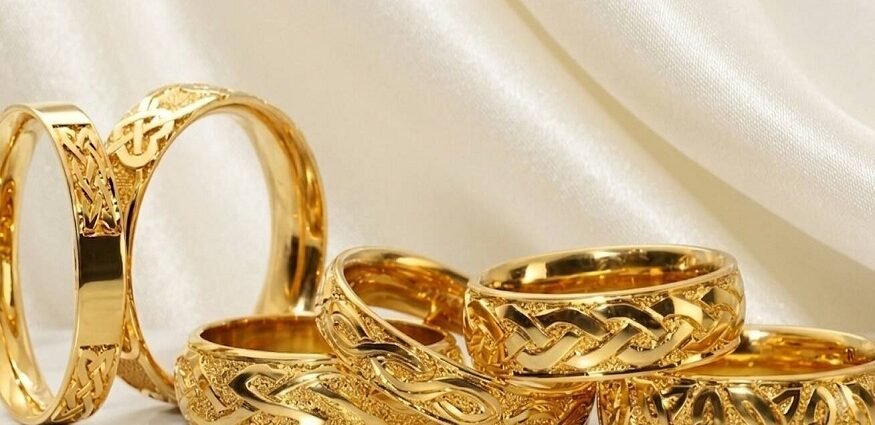
Rare materials do not often go on sale. That is what makes Clogau Outlet slightly unusual, and it is why the site rewards a little understanding before you start browsing. The jewellery stocked here is genuine Clogau jewellery containing rare Welsh gold, made to the same standard by the same company that has been working with the material since 1989. What has changed is not the metal, the making or the finishing. What has changed is where a particular design sits in the commercial cycle.
That distinction matters, because shopping an outlet well is a different skill from shopping a standing collection. A standing collection is stable. The piece you admired in March will still be listed in September, in your size, at the price you remember. Outlet stock behaves more like a tide. It fills up when ranges are refreshed, it drains as people buy, and the size you want in a particular design may exist in a quantity of one.
This guide is the practical side of that. Why pieces are discounted and why the reasons have nothing to do with quality; how to check what you are actually holding; how to browse stock that moves; how to use price bands and discount tiers rather than fighting them; and how to build a coordinated set for roughly what one full-price piece would cost.
Why Perfectly Good Jewellery Leaves a Current Range
Designs are retired for ordinary commercial reasons, and almost none of them are about the piece itself. Ranges are refreshed on a cycle so that the current collection stays current. A design that has been in the line for several years is eventually moved on to make room, regardless of how well it sold. Seasonal pieces run their course. Colour stories and stone choices that suited one year’s collection sit awkwardly in the next one.
Then there is the practical business of sizes. A design might be discontinued across most of its range while a handful of ring sizes, chain lengths or bangle diameters remain in the warehouse. Those end-of-line sizes are perfectly good jewellery with nowhere to go in a current catalogue. The discounted Clogau pieces gathered here are built substantially from exactly this kind of stock, and the Sale Items collection typically runs to several hundred pieces at any one time.
The last category is the past-season piece that never had anything wrong with it at all. A pendant designed for one winter collection is not improved or worsened by the arrival of the next winter collection. It is simply no longer the newest thing, and in jewellery, where a good design tends to outlive the season that produced it, that is a weak reason to pay full price.
What Discounting Does Not Touch
It is worth being blunt about this, because it is the question most people quietly want answered. Outlet pieces are not seconds, not factory rejects, and not a cheaper parallel line made to a lower specification. They are the same jewellery, from the same production, containing the same rare Welsh gold.
The Welsh gold itself is the reason the question matters. The Clogau St David’s mine sits at Bontddu, near Barmouth in Gwynedd, within Snowdonia, and between 1862 and 1911 it was Britain’s largest and richest gold mine, producing nearly 2.5 tonnes of gold. It closed for the last time in 1998, and there is no commercial Welsh gold mining today. Supply is finite in the most literal sense. A discount applied to a past-season design does not create more of the material, and it does not remove any from the piece in front of you.
Nor does it change the hand-finishing. Polishing, setting and assembly are done to one standard, and that standard was applied when the piece was made, long before anybody decided which collection it would end its life in. Discounts commonly run between 30 and 50 per cent off RRP, and every one of those percentage points comes out of the timing, not the workmanship.
Reading the Stamps Before You Buy
Verification is straightforward once you know where to look, and it is a habit worth having whenever you buy jewellery containing precious metal. Clogau pieces are identified by the Welsh dragon stamp together with the Clogau stamps. On a pendant this is usually on the reverse or on the bail; on a ring, inside the shank; on a bracelet, on the clasp or a dedicated tag.
The Hallmark: What the Assay Office Adds
Separately from the maker’s own marks, precious metal jewellery sold in the United Kingdom carries a hallmark struck by an assay office. This is the independent bit. It confirms the fineness of the metal, so you can tell at a glance whether you are holding sterling silver or gold, and it is applied by a third party rather than by the maker. Together with the dragon and the Clogau stamps, it gives you two separate confirmations of what you have bought.
Take thirty seconds with a piece when it arrives. Find the marks, look at them in good light, and put the paperwork somewhere sensible. If you are buying a gift, that small check is also a courtesy to whoever receives it, because provenance is part of what they are being given.
Outlet Stock Does Not Behave Like a Shop Window
Here is the single biggest adjustment for anyone used to shopping a standing range. Do not go hunting for one specific product. The piece you have decided on may not be there, and if it is there in the wrong size, no amount of patience will conjure the right one, because there is no reorder behind it.
The better approach is to browse broadly and decide late. Open the full outlet jewellery range with a shape in mind rather than a name: a drop pendant in silver, say, or a chunky bangle, or something with a blue stone. Scan the whole set, shortlist three or four candidates, then compare. People who shop this way consistently end up with pieces they would never have searched for, which is rather the point of an outlet.
The corollary is speed. If something is right, in your size, and you have thought about it for more than a day, buy it. A design that has been discontinued has a finite number of units in existence, and the last one of those goes to somebody. This is not artificial urgency invented for a sale banner. It is simply what end-of-line means.
Using Price Bands Instead of Fighting Them
Price is the most useful filter in an outlet, more useful than category, because it maps directly onto what you are actually trying to do. Somebody buying a small thank-you gift and somebody buying an anniversary pendant are not browsing the same shop, even though they are on the same site.
The Entry Band: Small Pieces, Small Outlay
For a first purchase, a stocking filler or a gift where you are not certain of taste, the range of Welsh gold jewellery under £50 is the sensible starting point. Stud earrings, slim pendants and single charms live in this band. It is also the least risky way to find out whether somebody likes Welsh gold before committing to something larger.
The middle band is where most everyday jewellery sits, and it is where the discount does the most visible work, because a 40 per cent reduction on a mid-priced pendant is the difference between a considered purchase and an easy one. The upper band holds the pieces with more gold, more stones or more complex construction, and it is where past-season status is worth the most in absolute terms.
Discount Tiers: Where the Real Value Hides
Not everything is reduced by the same amount. Within a range running from roughly 30 to 50 per cent off, the deepest reductions tend to attach to the designs that have been out of the current collection longest, which often means the more distinctive pieces rather than the safest ones. Sorting by discount rather than by price is a genuinely different exercise and turns up genuinely different results. It is worth doing both, in separate sessions, before you decide.
Building a Set for the Price of One Piece
The arithmetic of an outlet changes what a jewellery collection can be. At 30 to 50 per cent off, the budget that would have bought one full-price pendant will often stretch to a pendant, a pair of earrings and a charm, and three pieces that share a metal, a tone and a design language do something that three unrelated purchases never manage.
Start with the anchor. Choose one piece you will wear most often, usually a pendant, and let everything else defer to it. Then match the metal exactly rather than approximately, because silver next to rose-toned gold reads as a mistake whilst silver next to silver reads as a set. From there, the outlet earring selection is the natural second purchase, since earrings sit far enough from the neck to echo a pendant without competing with it.
Charms are the third element and the most forgiving one, because they are small, inexpensive and cumulative. Adding a piece from the Welsh gold charms available each time there is something to mark builds a bracelet slowly and gives the whole set a reason to keep growing. For a wider view of how the categories sit together, the women’s jewellery collection is the easiest place to see a coordinated group forming before you commit to any of it.
Conclusion: The Only Difference Is Timing
Welsh gold has historically commanded many times the price of standard gold, and its association with occasions of consequence is long established, including the rare Welsh gold used by some members of the British Royal Family for over 100 years and the wedding rings of 1947 and 1981. None of that history is diminished by a design leaving a current range.
What an outlet offers is a shift in when you arrive rather than what you get. Buy a piece the year it launches and you pay for its newness. Buy the same piece three years later, from stock that has been superseded rather than surpassed, and you pay for the metal and the making alone. The jewellery does not know the difference, and neither will anyone who sees you wearing it.
The practical advice reduces to this. Browse widely, check the stamps, shop by price band and by discount tier, and act when something is right in your size. Do that, and Clogau Outlet stops being a discount site and becomes what it actually is: a way into a finite material at the moment the market happens to be looking elsewhere.